Weekly Newsletter: March 8, 2026

Last week we introduced you to Andrew. He joined Seth and Sarah as our very part time campaign staff. All three are doing great work. Now we need to plan to expand the amount of work we can pay them for. April 17th is 200 days out from election day and by then we would like to double their hours and pay.
Our March fundraising goal is $10,000. If we hit that we can pay our workers for more work, do a major mailing to Greens across Maryland, and book our spring and summer festival schedule. That is a significant push for us and because we are in the public financing program we have to do it with a max donation of $250 per person (Our opponents in non-publicly financed campaigns can raise $12,000 per person).
I think if you look at the work we are doing in this week's newsletter and throughout the year it is clear, we are making a real and a material push for multiparty democracy in Maryland and we are building toward our campaign goals of being the strongest third party campaign in Maryland since the Civil War.
We have proven the concept, now we need to expand on it, and that takes money. So here is what we are asking for this week.
1) If you can donate $250 or add to your existing donation so it gets to $250, please do!
2) If you have not donated before and can't afford $250 (I certainly can't) a $5,$25, or $50 donation is greatly appreciated!
3) If you have donated before an additional $10, $25, or $50 is a big help.
4) If you are a recurring donor please consider adding an extra $5 per month. Email me and we will get it worked out.
If you can, donate now. It would help a lot and be greatly appreciated!
P.S. Our newsletter is awesome this week, and you don't have to donate to read it!
What Happened This Week
The full week in review is here.
Andrew Eneim started his first full week as our People and Organizing Lead. He published a message about what he's here to do. Read it.
Wednesday I provided testimony on four bills before the Government, Labor, and Elections Committee. HB 1405 was the one worth reading. The bill would ban campaign fundraising during session. Sounds good in theory. The problem: it helps incumbents who already have a huge advantage. Thursday, Andrew testified on SB 853, a prohibition on NDAs for public officials dealing with data centers.
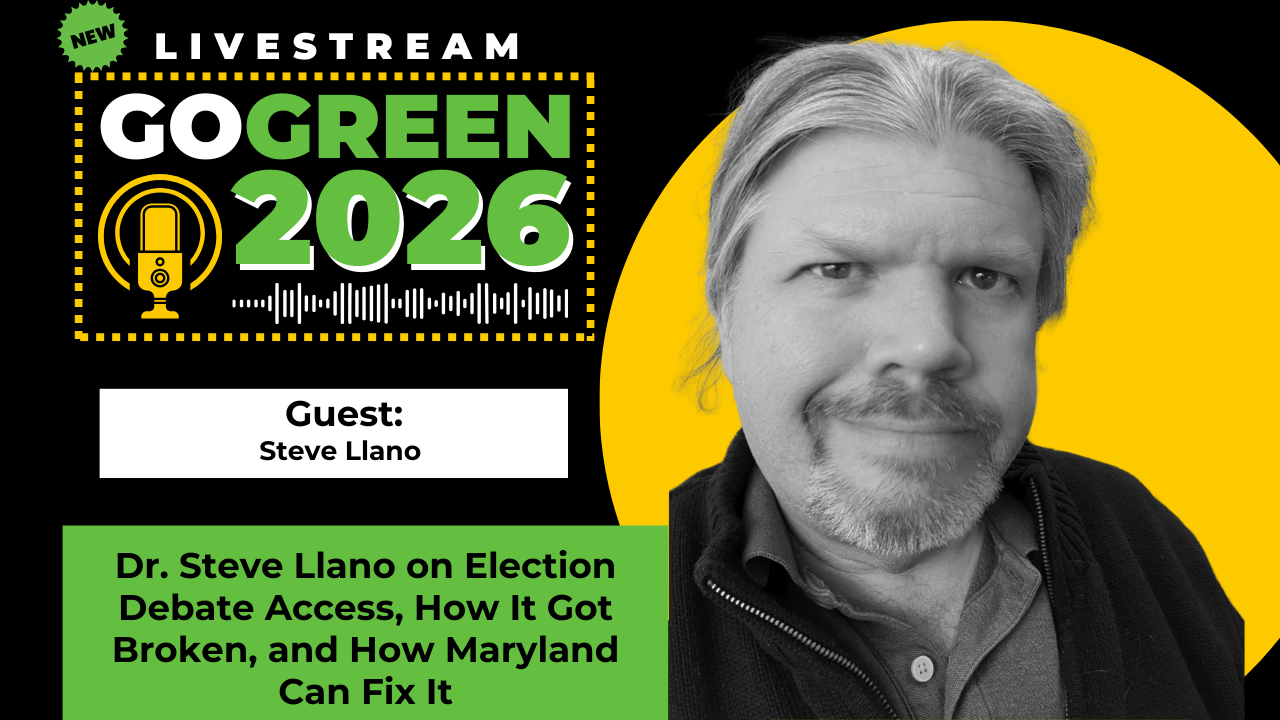
Thursday night Steve Llano joined the livestream to talk debate access and presidential debate reform. Watch the conversation.
Maryland Could Own This Soccer Team. It Should.
This op-ed was originally published in our newsletter.
I was excited to see the headline recently that a professional soccer team might be coming to Baltimore, but legislation heard this week in the Maryland General Assembly is the wrong approach. SB 883 and HB 1078 get three things wrong, and all three can be fixed.
The wrong place. Carroll Park has been public recreation space for over a century. During segregation, it was the only Baltimore golf course where Black golfers could play. The Pitch & Putt Golf Club, a Black women's club founded around 1938 and the second oldest in the country, played there. The Monumental Golf Club, a Black men's club formed in 1942, sued Baltimore for equal access and won in 1948. By 1951, all city golf courses were open regardless of race. Their fight catalyzed the integration of Baltimore's entire public recreation system by 1955. In 2022, the Pitch & Putt Club erected a monument at Carroll Park honoring that history.
SB 883 would replace the entire 60-acre golf course with a stadium and parking lot, exempt from normal planning and zoning review. Community leaders from Friends of Carroll Park and Citizens of Pigtown have publicly opposed the project.
A site study examined Swann Park as an alternative. DC United chose Carroll Park anyway.
The wrong funding. In 2020, Maryland voters legalized sports betting with the understanding that the revenue would support public schools. Since then, $244.9 million has gone to education through that mechanism.
SB 883/HB 1078 authorize $216.6 million in state bonds for the Carroll Park soccer stadium. The bill repays the stadium bonds, principal and interest, through that same sports wagering revenue. The stadium gets paid for before the Blueprint for Maryland's Future education fund receives a dollar.
Maryland faces a $1.4 billion budget deficit in FY2027, projected to grow to $2.1 billion by FY2028. The state has already spent over $670 million in debt service on Camden Yards alone. The supporters of these bills are trying to offset the cost to taxpayers. But taking the money from public education doesn't actually save taxpayers money, it just shifts the debt to schools.
The wrong ownership. Under this deal, taxpayers fund the stadium and DC United captures the revenue. Game-day sales, broadcast rights, merchandise, naming rights. The public bears the risk. The private owner collects the profit. This is the same model that produced a $1.3 billion public commitment to the Orioles and a $600 million bond package for the Ravens that is already $55 million over budget.
Eighty-three percent of economists surveyed by the University of Chicago say stadium subsidies are not worth the cost. The pattern in Maryland is the same as everywhere else: public money in, private profits out, and the next deal is always bigger than the last one.
I have been advocating for public ownership of professional sports teams as part of this campaign since 2023. The argument is simple: taxpayers should not subsidize private owners when they can own the teams themselves. But this one also presents the clearest opportunity yet to do something about it.
A better deal. Major League Baseball and the NFL both ban community ownership. They can do this because federal antitrust protections shield their league rules from legal challenge. Soccer has no such protection. No federal law prevents a community from owning a soccer team. For baseball, you need Congress to change the rules. For soccer, you just need the will.
Community ownership already works in American sports. Many people are familiar with the Green Bay Packers, but the real opportunity for public ownership is in minor leagues of professional sports. In Chattanooga Tennessee, more than 3,200 fans bought shares in their local soccer club for less than $1 million. The club now plays in MLS Next Pro, the same league as the proposed Carroll Park men's team. In Harrisburg Pennsylvania, the city bought its minor league baseball team in 1995 for $6.7 million, ran it profitably for twelve years, and sold it for $13.25 million with a 29-year commitment to stay. Those are models we should use if Maryland's six minor league baseball teams playing in taxpayer-funded stadiums ever threaten to leave.
But Baltimore does not need to buy an existing team. There is no team yet. The state has the chance to build something community-owned from the start. Work with Baltimore residents to find a site that has community support. Go through the normal planning process. And instead of handing the franchise to a DC ownership group, structure it so the city and the fans own the teams that play there.
Carmelo Anthony is a Baltimore native and an NBA Hall of Famer already investing in this project. Imagine if he said: join me in owning a piece of Baltimore soccer. Over three thousand people invested in Chattanooga's club. Baltimore is three times that city's size. We know this ownership model works and now is a great time to embrace it.
Baltimore deserves professional soccer. It should own the teams, not just the building.
What's Coming Up
Three Stories We're Watching
Two Israel-Palestine bills head to committee. HB 1382 would stop Maryland from requiring businesses to certify they aren't boycotting a foreign country as a condition of state procurement. HB 1455 would require the state pension system to divest from companies profiting from the occupation of Palestinian territories. Anti-BDS laws are speech restrictions dressed up as procurement policy. Divestment is how a state says its retirees' money has limits. Both bills reflect platform priorities for our campaign
Youth Charging Reform Act passes the Senate 32-12. SB 323 ends automatic charging of children as adults. This is a reform that has been pushed for years and this year might be the year it passes. This is also a platform priority for our campaign
Education platform launches as workers' rights bills get hearings. We're releasing our education issue page Wednesday, the same day HB 1492 (right to strike for school and library employees) and HB 1205 ($25/hr minimum for education support professionals) go before House committees. We built an eight-plank education platform with specific policy mechanisms. Wednesday is a good day to read it.
Legislation
Hearings this week:
- Mon 3/9: HB 979 (constitutional convention reform) — House Rules and Executive Nominations
- Wed 3/11: HB 1382 (anti-BDS procurement) — House GLE
- Wed 3/11: HB 1492 (right to strike, 23 co-sponsors) — House GLE
- Wed 3/11: HB 1205 (education support professional wages, 20 co-sponsors) — House Ways and Means/Appropriations
Livestream
Thursday, March 12 at 7 PM on YouTube. Three segments: stories from the week in Annapolis, a deep dive on our education platform, and a conversation about what it costs to run this campaign. Watch live.
Three Things You Can Do This Week
1. Volunteer. Andrew is building this campaign one conversation at a time. If you want to get involved, sign up to volunteer. He's not going to spam you. He's going to talk to you.
2. Subscribe to our YouTube channel. Every Thursday at 7 PM we go live. The show is where we break down what happened in Annapolis, interview guests, and make the case for why this campaign matters. Subscribing is free and it helps more people find us. Subscribe.
3. Donate. We made the case above. If you can, donate now.
Thank you for your support. Every action puts us closer to 100,000 votes and the Maryland we all deserve.
In solidarity,
Andy Ellis
gogreen2026.com