Weekly Newsletter: February 22, 2026
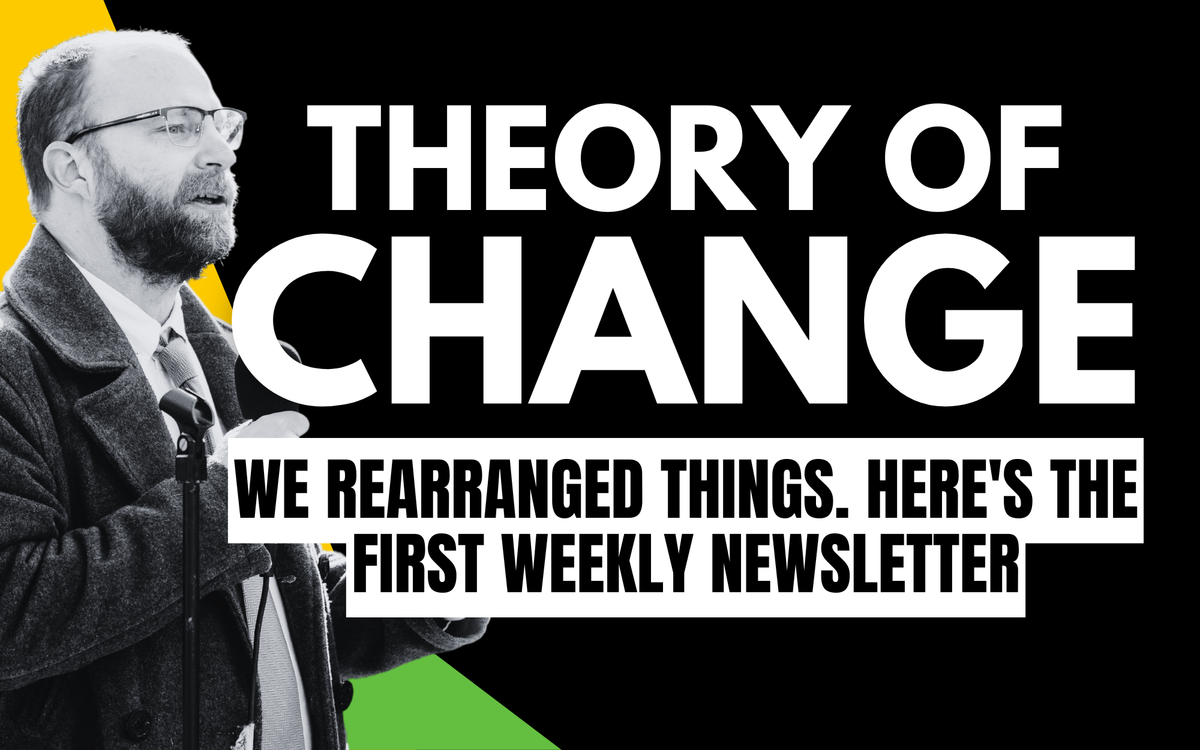
We've been sending a lot of email. When I looked at the volume, it started feeling like too much. Nobody signs up for a campaign email list hoping to hear from us four times a week.
So, we rearranged things. Most weeks, you'll get two emails from us: this newsletter on Sundays, and a livestream reminder on Thursdays. The newsletter covers what happened and what's coming. The deeper reporting goes on our blog. Thursday's email tells you what we're covering that night and where to watch.
Here's my ask: if this is useful, share it. Forward it to someone. Send them the signup link. The more people on this list, the more this campaign can reach without spending money we don't have. Word of mouth is our best channel. It's priceless, and it costs nothing.
Last Week
Three press releases, two testimonies, two happy hours, one Annapolis day, one livestream, and a trip to St. Mary's County. We tracked three stories where the big picture was missing: 243 million gallons of sewage in the Potomac, a statewide Inspector General gap, and a State of Maryland AI contract with more questions than answers. Governor Wes Moore signed the 287(g) ban, abolishing local law enforcement's cooperation with ICE, and nine sheriffs said they'd ignore it. We testified on student civic engagement and ranked choice voting. Thursday's livestream brought on guests from Baltimore and DC to talk about public energy ownership.
It was a great week!
The full week in review is here: February 15-21, 2026
The Way Forward for Multiparty Democracy in Maryland
This op-ed was originally published on our blog.
Last year, after a panel discussion, I was talking with Senator Charles Sydnor, and I kept saying "two-party system." He stopped me. We don't have a two-party system, he said. You're on the ballot. You have a party. You're advocating to change things. Stop acting like you don't exist.
He was right. Maryland doesn't have a two-party system. Maryland law explicitly creates two classes of political parties: principal parties (the Democrats and Republicans) and non-principal parties. Greens, Libertarians, the Working Class Party. We collect signatures, qualify for ballot lines, and run candidates. The question isn't how to break a two-party system. It's how to make the multiparty system we already have actually work. That means elected officials who have to earn votes from every community instead of assuming them, and a supermajority that has to negotiate instead of governing unchecked.
The demand is there. According to Gallup, forty-five percent of Americans now identify as independents, a record high. Sixty-two percent say a third party is needed. According to the State Board of Elections, nearly one million Maryland voters are registered as unaffiliated. People are leaving the two parties because they want another choice.
I talked about this recently with Dayvon Love of Leaders of a Beautiful Struggle. He puts it bluntly: the Democratic Party has an exploitative relationship with its Black working-class base. It panders when it needs votes, but will not advance the policies that would shift real power to communities. Without a credible political threat to its left, that will not change. The cost is concrete: policies that would address the material conditions of Black communities get delayed, vetoed, or watered down because there is no electoral consequence for failing to deliver. What communities need are alternatives with enough structural support to change outcomes, not just more choices on paper.
I've been working on this for a decade. This session, I testified on a suite of bills targeting the barriers that keep non-principal parties from competing. These are things the General Assembly can pass right now.
Debate access. HB 101 would require any public broadcaster receiving state funds to invite all ballot-qualified candidates to general election debates for statewide office. Maryland Public Television currently sets a 10% polling threshold. No candidate outside the two principal parties has reached 10% since Reconstruction. That threshold doesn't filter for quality. It filters out an entire class of legally recognized parties.
Ballot access. The Green Party has petitioned to get on the ballot seven times, more than any party in state history. Every time, roughly 30% of signatures are invalidated because of paper-form technicalities. When electronic signatures were piloted during COVID, the validation rate jumped above 90%. HB 499 would make electronic petitions permanent and let voters cure the technical errors.
Public financing. Our campaign is the only active statewide campaign using Maryland's Fair Campaign Financing Fund. As political scientist Dr. Bernard Tamas describes it: "Third parties are stuck in a vicious cycle of not being able to build resources because they are seen as unable to win, and unable to increase their voter support because they cannot raise resources." HB 568 would extend public financing to legislative candidates, breaking that cycle in every district.
Ranked choice voting. HB 580 would give Montgomery County the authority to study and adopt ranked choice voting, which lets people vote their values without fear of wasting their vote. Takoma Park has already done it successfully; Greenbelt recently adopted it. SB 236 would ensure that, as we modernize how we vote, the systems that count our votes are rigorously certified.
Most of these bills will not pass this session. I know that. They are a starting point for a bigger agenda. Beyond what is on the table this year, Maryland needs public financing for the parties themselves, not just individual candidates, and proportional representation in the House of Delegates, the single reform most likely to put multiple parties in government. That agenda is years away.
But every bill that passes, every hearing where these arguments get made, every voter who registers outside the two parties is part of building the infrastructure to get there. Dayvon pressed me on something in our conversation that I think matters: if you are going to use a ballot line to challenge the existing power structure, you have to own the consequences of doing so. The two parties are not the same. But they agree on enough that someone has to be willing to hold them accountable at the ballot box. That is real power, and wielding it responsibly is what separates serious politics from protest.
Maryland already has the legal framework for a multiparty system. What it does not have is the infrastructure to let that system function. This is not a protest. It is patient, serious work to make Maryland's democracy match what its own laws already promise.
Week Ahead
Three Stories We're Watching
The soccer stadium. SB 883 would authorize $217 million in bonds for a soccer stadium at Carroll Park and embed a revenue-sharing clause that puts wagering revenue ahead of state education funding. Community opposition is growing. Hearings are on March 3 and 5. We're preparing to testify in opposition.
The filing deadline. Tuesday at 9 PM is the deadline for Democratic and Republican candidates to file. We filed months ago. By Wednesday morning, the rest of the field takes shape. We'll be looking at how many races have only one major-party candidate, what that says about Maryland democracy, and what the governor's race looks like.
Immigration enforcement after the 287(g) ban. It's been five days since Moore signed the ban. Nine county sheriffs said they'd ignore it. We'll be tracking how many counties are still cooperating with ICE and what workaround policies look like on the ground. The next fight is a Community Trust Act with real enforcement.
Testimony
Wednesday, we're testifying on HB 0962 (public campaign financing for school boards), HB 1010 (election technology certification), HB 1289 (ranked choice voting task force), and the Community Trust Act (SB 791 / HB 1575). That brings us to 13 testimonies this session.
Livestream
Thursday at 7 PM on YouTube. We'll cover all three stories, the week in Annapolis, and be joined by Carlos Orbe Jr. Carlos is the founder of Mind-full Communications, based in Montgomery County. He focuses on policy and communications that impact under-resourced and minority communities, primarily Latinos. He has worked in coalition with Owen to hold the Maryland State Department of Education accountable and to pass the Credit for All Language Learning Act of 2024. This week is the halfway point of the 2026 legislative session, and Carlos will join us to talk about what he's working on and what he's watching for. Watch live.
Support the Campaign
The campaign gets busier every day. We have people doing real, regular work. And we need to pay them.
Andrew Eneim is joining the team. He organized the grad student union at Johns Hopkins. If you want to know what kind of person he is, watch his interview. Seth writes video scripts, edits our editorial content, and is developing the campaign comic book. He meets with me twice a week to shape the arguments. His interview is here. Sarah does video editing, thumbnails, clips, and schedules everything across every platform. She's the reason the segments look right and show up on time.
These are real people doing consistent work. The press releases, the testimonies, the show prep, the clips, the email you're reading right now.
We need money to keep them. Not eventually. Now.
This campaign doesn't take corporate money. We don't have a billionaire donor. We have you, and we have Maryland's public financing system, which matches small donations from Maryland residents. Every dollar you give gets matched and goes directly to paying the people building this.
If you've already donated this month, thank you. If you haven't, this is the ask.
In solidarity,
Andy Ellis
gogreen2026.com